GEO for B2B and professional services firms: what should you do?
B2B buyers now use AI tools early in their research, and several surveys say so. Here is what those surveys found, how far they stretch to law, accounting and consulting firms, and what we'd do.
A law, accounting or consulting firm should treat AI answers as a place where its name either turns up or doesn't when a buyer is building a shortlist, and the work is the same sort of work as good search marketing: a site the engines can read, clear pages that answer real questions, and mentions of your firm in the places they read. Surveys say a large share of B2B buyers now use AI tools in research. None of the ones we could open was about law or accounting buyers, so we'd read the figures as a signal about B2B in general and not as a count for your practice area.
What the surveys say
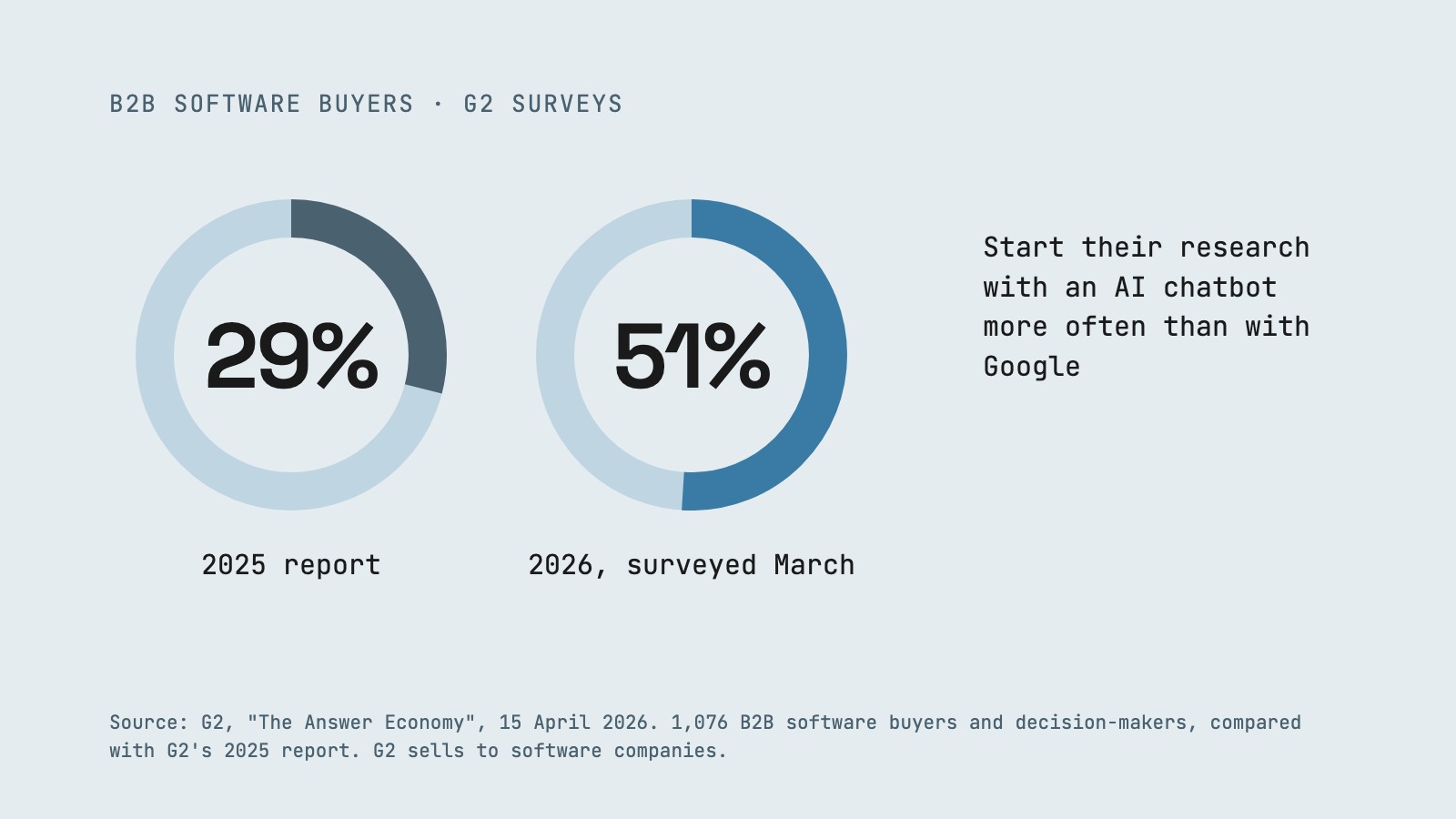
G2 surveyed 1,076 B2B software buyers and decision-makers in March 2026 and reported on 15 April 2026 that 51% "now start their research with an AI chatbot more often than with Google," up from 29% in its 2025 report. G2 sells reviews, buyer intent data and advertising to software companies, so this is a vendor study, and it covers people buying software.
G2's later 2026 buyer report, published on 22 July 2026 and based on more than 1,000 B2B software buyers, found that 82% had sourced a software recommendation from an AI chatbot in the last 24 months. It also found that chatbots shaped the shortlist for 37% of buyers, just behind review sites at 38%. The two reports ask different questions, so 51% and 37% don't contradict each other. One is about where research starts and the other is about what shaped the shortlist.
Forrester, an analyst firm that sells research, wrote on 22 January 2026 that "the proportion of buyers using AI only grew five percentage points, to 94%," and that 61% use private AI tools provided by their organisation. Its post doesn't state the sample size, so we can't say how many buyers that rests on.
Responsive, which sells RFP software, surveyed 350 B2B buyers and reported on 15 October 2025 that generative AI had overtaken traditional search for a quarter of them. In the same study, industry expertise (52%) mattered more to buyers than price (49%), which is the part we'd pay most attention to if we ran a professional services firm.
Why this matters when you sell a service
John Dawes of the Ehrenberg-Bass Institute wrote that "Corporations change service providers such as their principal bank or law firm around once every five years on average." He estimates that "only 20% of business buyers are 'in the market' over the course of an entire year", which is the idea behind the 95:5 rule. The AI answer matters in two places: when a buyer does start looking and asks for names, and earlier, when a buyer asks a general question and one firm's explanation gets quoted.
What the engines say about getting in
OpenAI is plain that "Placement is not guaranteed" in ChatGPT search, and Google's guidance says optimising for generative AI search is "optimizing for the search experience, and thus still SEO." Our note on getting your brand mentioned in ChatGPT covers the crawler settings, so we won't repeat them here.
What we'd do
This part is our advice. First, ask the AI tools the questions your buyers would ask, such as "who are good employment lawyers for a mid-sized company in Cork?" or "how should a growing business choose an accountant?", with search turned on. Note who is named and which sources are cited, and repeat each question a few times because answers change.
Second, put the specifics on your own site. A page per practice area or service, with the answer in the opening sentence, who it is for, what you charge or how you price, and who at the firm wrote it. Google's own self-check asks whether a page shows "evidence of the expertise involved" and "background about the author," so partner pages with real experience are worth more than a line about being client-focused.
Third, look at the other pages the AI tools cite: directories, professional body listings, trade press, award lists, review sites. Those are where the shortlist is often decided, and getting listed accurately there is closer to PR than to web work.
Fourth, don't chase tricks. Google says there is no special file or markup to add. And in our view no firm can promise you a place in an answer.
Read next: GEO vs SEO vs AEO: what's the difference?, How to write content AI tools will quote and What to ask before hiring a GEO agency.
This note was drafted with AI and checked by Paul Dervan before it was published.
Sources
G2, "The Answer Economy" research, 15 April 2026: company.g2.com. G2, 2026 Buyer Behavior research, 22 July 2026: company.g2.com. John Buten, Forrester, "B2B Buyers Make Zero-Click Number One", 22 January 2026: forrester.com. Responsive, "Inside the Buyer's Mind", press release, 15 October 2025: responsive.io. John Dawes, Ehrenberg-Bass Institute, May 2021: marketingscience.info. OpenAI Help, ChatGPT search: help.openai.com. Google Search Central, "Optimizing your website for generative AI features on Google Search": developers.google.com. Google Search Central, "Creating helpful, reliable, people-first content": developers.google.com.