How do Google's AI Overviews choose their sources?
Google says a page needs to be indexed and eligible for a snippet, and that there are no extra requirements. Independent studies disagree on how closely the links follow the ordinary results.
Google's own answer is short. To be shown as a supporting link in an AI Overview or in AI Mode, "a page must be indexed and eligible to be shown in Google Search with a snippet," and "There are no additional technical requirements." That is from its AI features page, last updated 10 December 2025. Google's newer guide to generative AI features, updated 10 July 2026, adds one step: "In addition to the technical requirements for Search, a site must be included in Search generative AI features in Search Console to be eligible for display in generative AI features on Google Search." Beyond that, Google doesn't say how it picks between eligible pages. What it does describe is a step before the pick: both features "may use a 'query fan-out' technique, issuing multiple related searches across subtopics and data sources." So the pages come from several searches, not only the one you typed.
What Google's own pages say
Google Search Central's page on AI features and your website adds that "our advanced models identify more supporting web pages" while the answer is being written, which lets Google "display a wider and more diverse set of helpful links." It also says there is nothing special to add to your site for these features, which matches what we wrote about GEO, SEO and AEO. Google's announcement of AI Mode describes the same idea as "issuing multiple related searches concurrently across subtopics and multiple data sources," and says that if the system lacks high confidence in an AI answer, "the response will be a set of web search results."
AI Mode
Google describes AI Mode as "particularly helpful for questions that need further exploration, comparisons and reasoning." Google's page on AI features covers AI Mode and AI Overviews together, and the eligibility rules are the same for both. But the same page says "AI Mode and AI Overviews may use different models and techniques, so the set of responses and links they show will vary."
Do the links follow the top ten results?
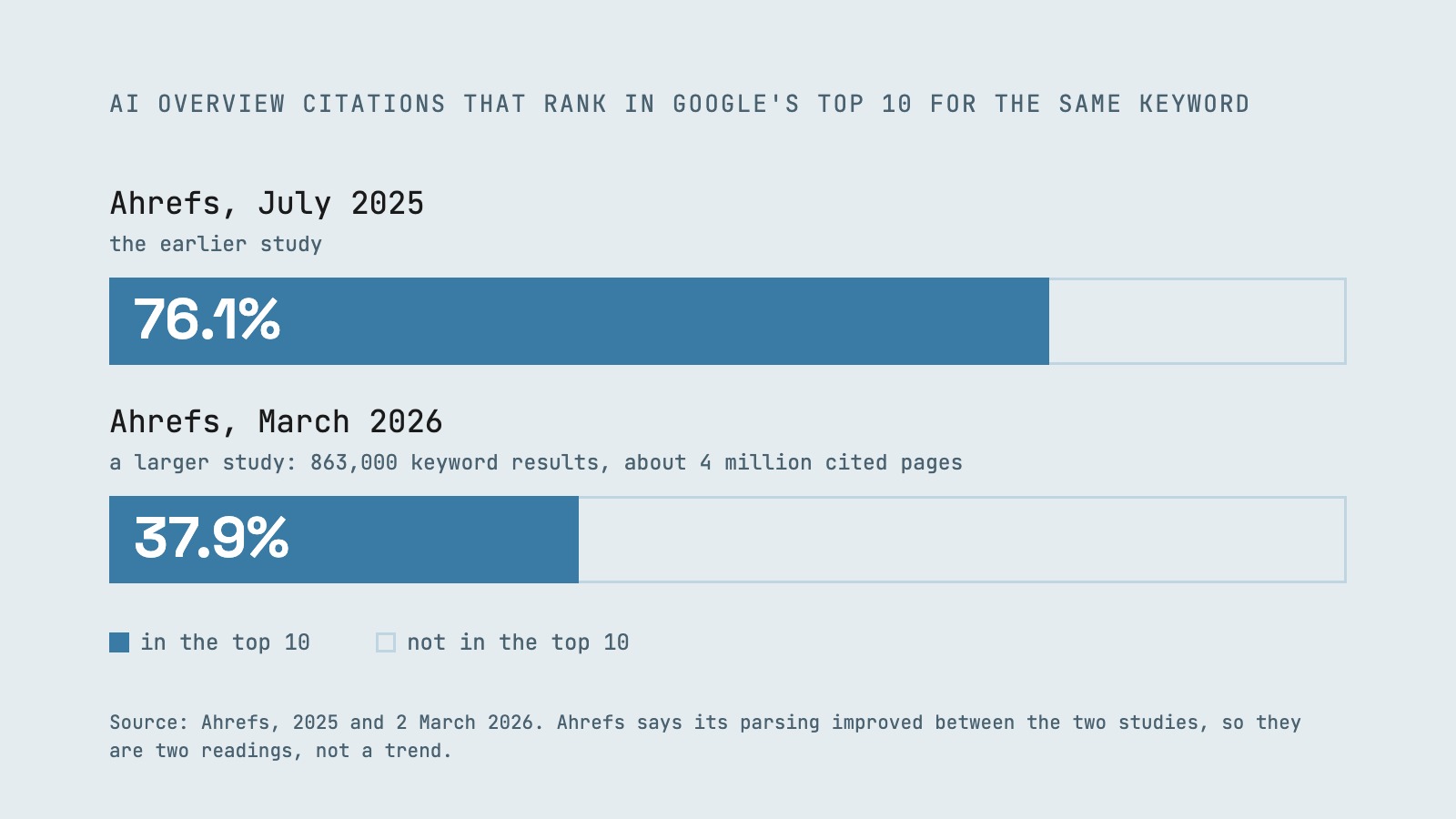
It depends on when and how you measure. Ahrefs, which sells SEO software, reported in July 2025, from 1.9 million citations in 1 million AI Overviews, that 76.1% of cited pages ranked in Google's top 10 for the same keyword. That study only looked at "the top 3 most visible citations in each response". In March 2026 it ran a larger study on its own Brand Radar data, covering 863,000 keyword results and about 4 million cited URLs, and found 37.9% in the top 10. Ahrefs says its parsing improved in between, and the first study counted only the top three citations, so the two figures can't be drawn as a straight line. It suspects query fan-out plays a bigger part, and points out that Google doesn't expose its fan-out queries. In that same March study, among cited pages that didn't rank in the top 100, 18.2% were YouTube.
An academic team (Grossman and colleagues, accepted at SIGIR 2026) used a public benchmark of 11,500 queries and compared Google Search, its AI Overview and Gemini Flash 2.5. They found the sources retrieved differ a good deal between the three, with average Jaccard similarity below 0.2 (a score where 1 would mean identical sets). They also found generative engines more likely to retrieve Google-owned content than ordinary search is. Semrush, which also sells SEO tools, reported in November 2025 that AI Mode "has a clear preference for Google's owned domains", based on 13 weekly snapshots of more than 230,000 prompts across several platforms.
These studies don't contradict each other as much as they look. One asks how many cited pages sat in the top 10. Another asks how much the source sets overlap between engines. A third asks which domains turn up most. But they do disagree on the headline point, which is that the older study says AI Overviews mostly follow the top 10, and the newer one says well under half do.
What we'd do with this
This part is our advice. Since Google says the only entry test is being indexed and snippet-eligible, check that first: is the page in Google's index, and is anything blocking a snippet? After that, rank well for the question and also for the sub-questions around it, since fan-out searches those. A page that answers the follow-up questions a buyer would ask has more routes in. We wouldn't plan around a "top 10 share" figure from any one study, because the figure moved a lot between the two Ahrefs studies.
Read next: GEO vs SEO vs AEO: what's the difference?, Does Google penalise AI-written content? and Which sources do AI tools cite most?.
This note was drafted with AI and checked by Paul Dervan before it was published.
Sources
Google Search Central, "AI features and your website": developers.google.com. Google, "Expanding AI Overviews and introducing AI Mode": blog.google. Ahrefs, "Update: 38% of AI Overview Citations Pull From The Top 10", 2 March 2026: ahrefs.com. Ahrefs, "76% of AI Overview Citations Pull From the Top 10", 2025: ahrefs.com. Grossman et al., "How Generative AI Disrupts Search", arXiv 2604.27790, April 2026: arxiv.org. Semrush, "The Most-Cited Domains in AI: A 3-Month Study", 10 November 2025: semrush.com. Google Search Central, "Optimizing your website for generative AI features on Google Search", updated 10 July 2026: developers.google.com.