What is zero-click search?
Zero-click search is a search that ends without the person clicking any result. Here is what the studies measure, what the numbers can and can't tell you, and what to do when nobody clicks.
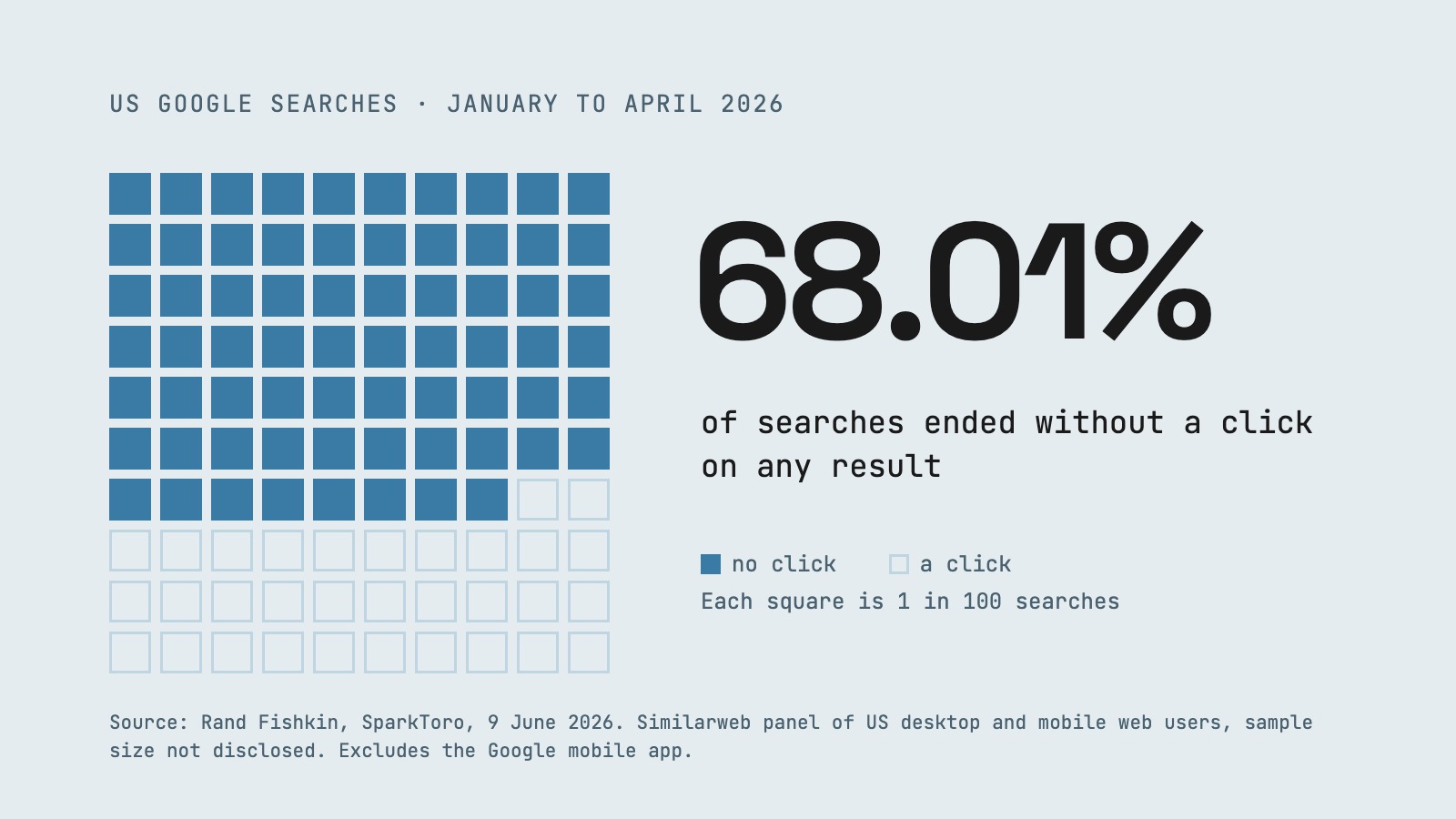
A zero-click search is a search that ends without the person clicking on any result. They get what they need from the results page itself, such as a snippet, a map, a box of facts or an AI-written summary, or they give up. SparkToro, which sells audience research software, measured it at 68.01% of US Google searches for January to April 2026. That figure counts every search, including ones where the person had nothing more to do, so it doesn't mean 68% of searches failed to help anyone.
What the studies found
The most widely cited work is by Rand Fishkin at SparkToro, using clickstream panels from other companies. A clickstream panel records the web pages a group of consenting people visit.
His 2024 study used a panel from Datos, a Semrush company, covering September 2022 to May 2024. It found that 58.5% of US Google searches and 59.7% of EU searches ended with no click. For every 1,000 US searches, 360 clicks went to the open web, meaning to sites that Google doesn't own or pay for. Almost 30% of all clicks went to platforms Google owns. SparkToro describes the panel as "tens of millions of panelists", with no exact count for the US and EU parts, and says "iPhones aren't included". SparkToro's later 2026 post, using a different panel, gives 60.45% for 2024, so the two panels disagree by a couple of points for the same year.
His 2026 study used Similarweb's panel of US desktop and mobile web users for January to April 2026 and found 68.01%. SparkToro didn't disclose the sample size, and it says the comparison with 2024 is "a bit of apples and oranges" because the panels differ. It excluded the Google mobile app, where zero-click behaviour may be even higher. Only 0.34% of searches in that period went into Google's AI Mode.
Pew Research Center, a non-profit, took a different route. It tracked the browsing of 900 US adults for March 2025 and found that about two-thirds of Google searches ended with the person browsing elsewhere on Google or leaving the site without clicking a link in the results.
What it means for a business
Our view is that fewer clicks per search means ranking in the top three no longer brings the traffic it did. We think the pages that lose most are those that give a fact anyone could look up, because the results page now gives it, and that pages people have to visit to do something, such as buy, book, compare or download, are less exposed.
It also doesn't mean the visits stop mattering. The people who do click have often read an answer first and clicked to go further, which is Google's argument about click quality. Google's post gave no figures for it, and we look at it in Do Google's AI Overviews reduce clicks?.
What counts as value when nobody clicks
This part is our advice.
Being named still has value. Someone who reads an AI answer or a snippet that names your firm has seen you, and when they later need what you sell, you are more likely to come to mind. That's the same idea as mental availability, and it's why we'd treat a mention as a real result and not a consolation prize.
So measure more than visits. Track how often your brand is named when you ask the questions your buyers ask, in Google and in the AI tools. Track branded search, which is people typing your name, and track direct visits and enquiries that say "I saw you mentioned". None of these is exact, and we'd say so when we report them.
Write for the answer being copied out of your page. If your best sentence is lifted into a summary, make sure your name and what you do are next to it, so the person who only reads the summary knows whose it is.
And keep the pages that people must visit in good shape. A pricing page, a booking page and a clear contact route matter more, not less, when the casual traffic falls.
Read next: Is SEO dead?, Do Google's AI Overviews reduce clicks? and Why does brand matter in AI search?.
This note was drafted with AI and checked by Paul Dervan before it was published.
Sources
Rand Fishkin, SparkToro, "In 2026, Less than One Third of Google Searches Still Send a Click", 9 June 2026, last modified 18 June 2026: sparktoro.com. Rand Fishkin, SparkToro, 2024 zero-click search study with Datos data: sparktoro.com. Pew Research Center, "Google users are less likely to click on links when an AI summary appears in the results", 22 July 2025: pewresearch.org. Liz Reid, Google, "AI in Search is driving more queries and higher quality clicks", 6 August 2025: blog.google.