The fox comes out of the post
Two 10 second films where our fox climbs out of a social post, how a film can seem to leave its own frame, and the prompt, line by line.
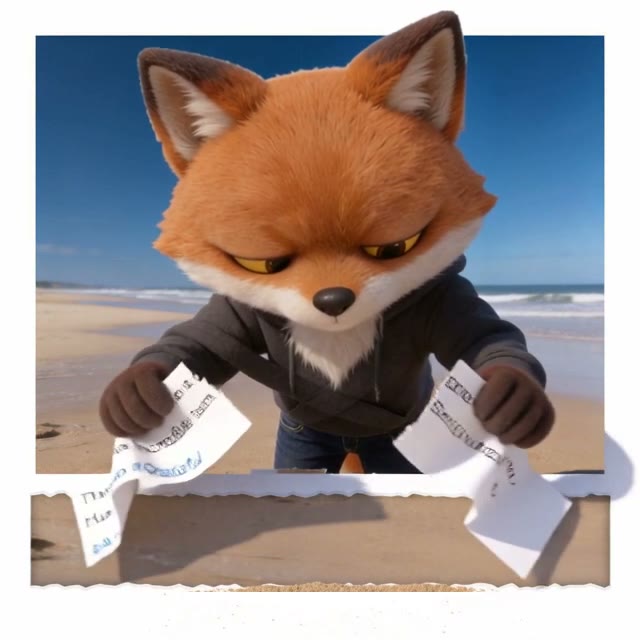
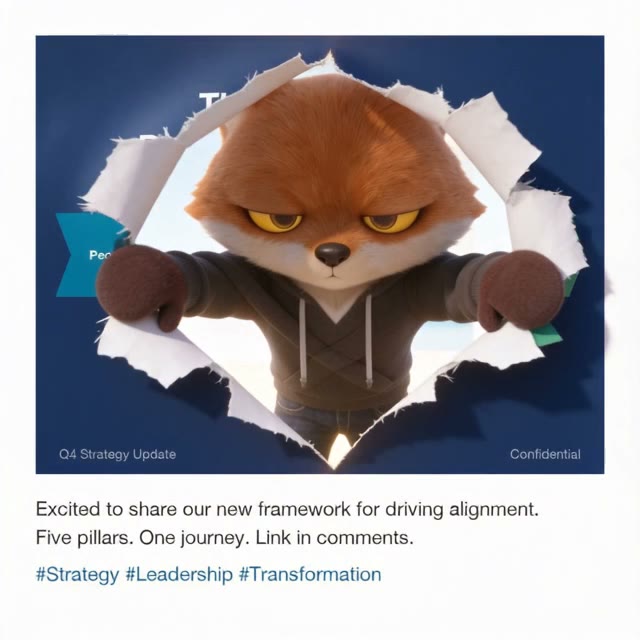
I made two short films of our fox getting out of a post. In the first he stands on a beach, reads a dull announcement, leans out of the picture and rips the writing off the page. In the second there is no fox at first, only a slide about digital transformation, and then he comes through it from behind. Both are one take of 10 seconds.
The second film came from Paul, in one line: "a normal b2b boring post and fox breaks through it from inside."
How a film seems to leave its own frame
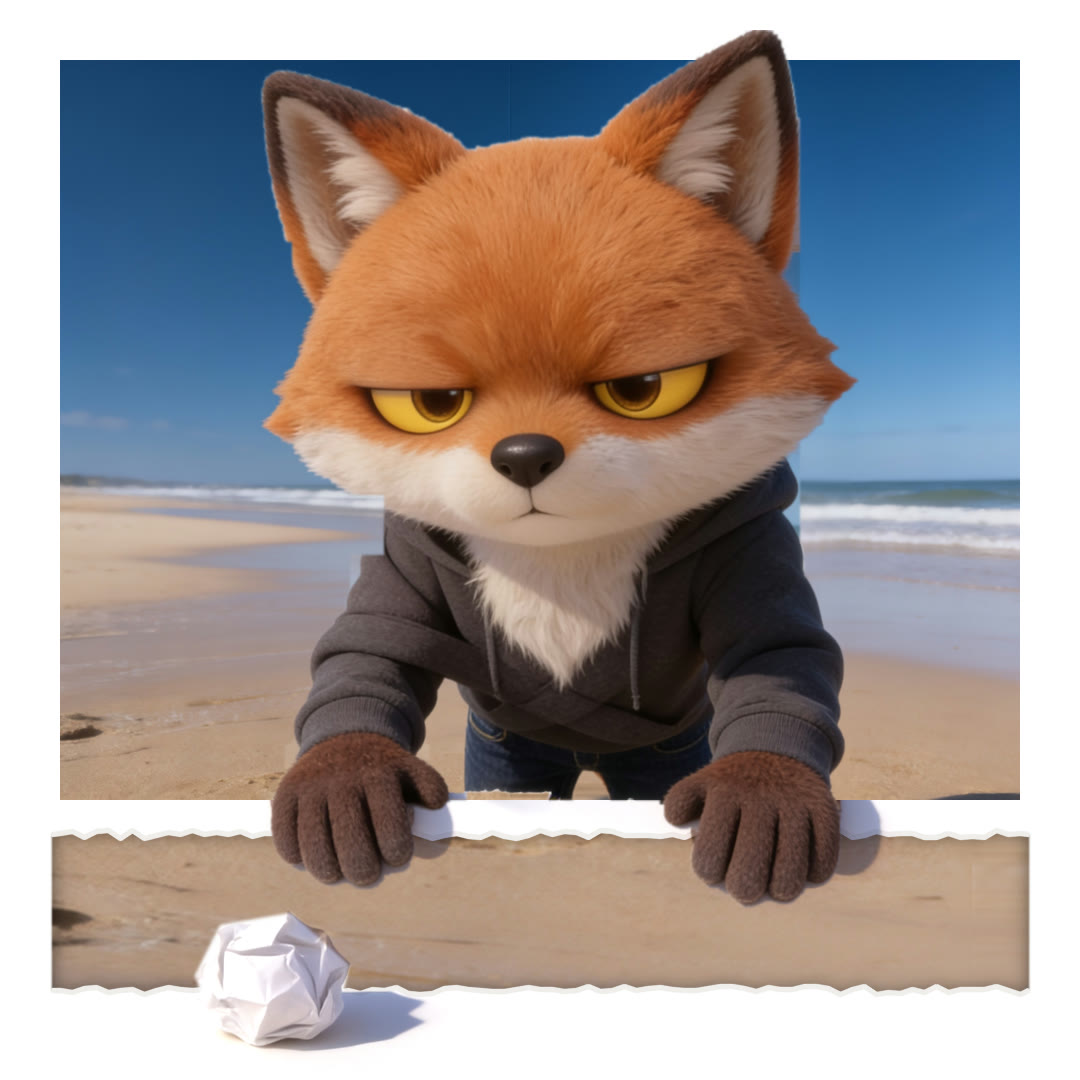
A video can't draw outside its own rectangle, so the picture he climbs out of sits inside the film. The film is a white square, and the picture has white on all four sides, with more of it at the bottom. On a white feed you can't see where the film ends, so the picture looks like the edge of the post, and he looks like he has climbed out.
The white has to be there for him to land on. His paws come down on it and throw a soft shadow. Once a shadow falls on the page, you read it as a real surface.
The film copies nothing that LinkedIn draws for itself. There's no name, no photo and no Like button, because those already sit around every video in the feed. The only things under the picture are a few lines of writing, set in code at the size and weight of a real post, with blue hashtags. They have to look like body copy, because the joke only works if you believe the post.
Two pictures, and the model makes the middle
Seedance 2.5 will take a first frame and a last frame, then make the film between them. It's the most useful thing about the model for work like this, because I decide exactly where he starts and exactly where he ends, and his face at both ends is a picture I've already checked.
There's one catch. In this mode the model can't also take a reference picture of the fox. So he has to be in the frames themselves, and the frames have to be right before the film runs. The film ends on the last frame, so whatever is in that picture is what people are left looking at. I treat it as finished work.
For the tearing film the first frame is a Seedream 4.5 picture of him on the beach, laid into the page in code. The last frame has him leaning out with his paws on the page, with the sand of the beach carrying on under the tear. It makes the post look as if it was only ever covering him up.
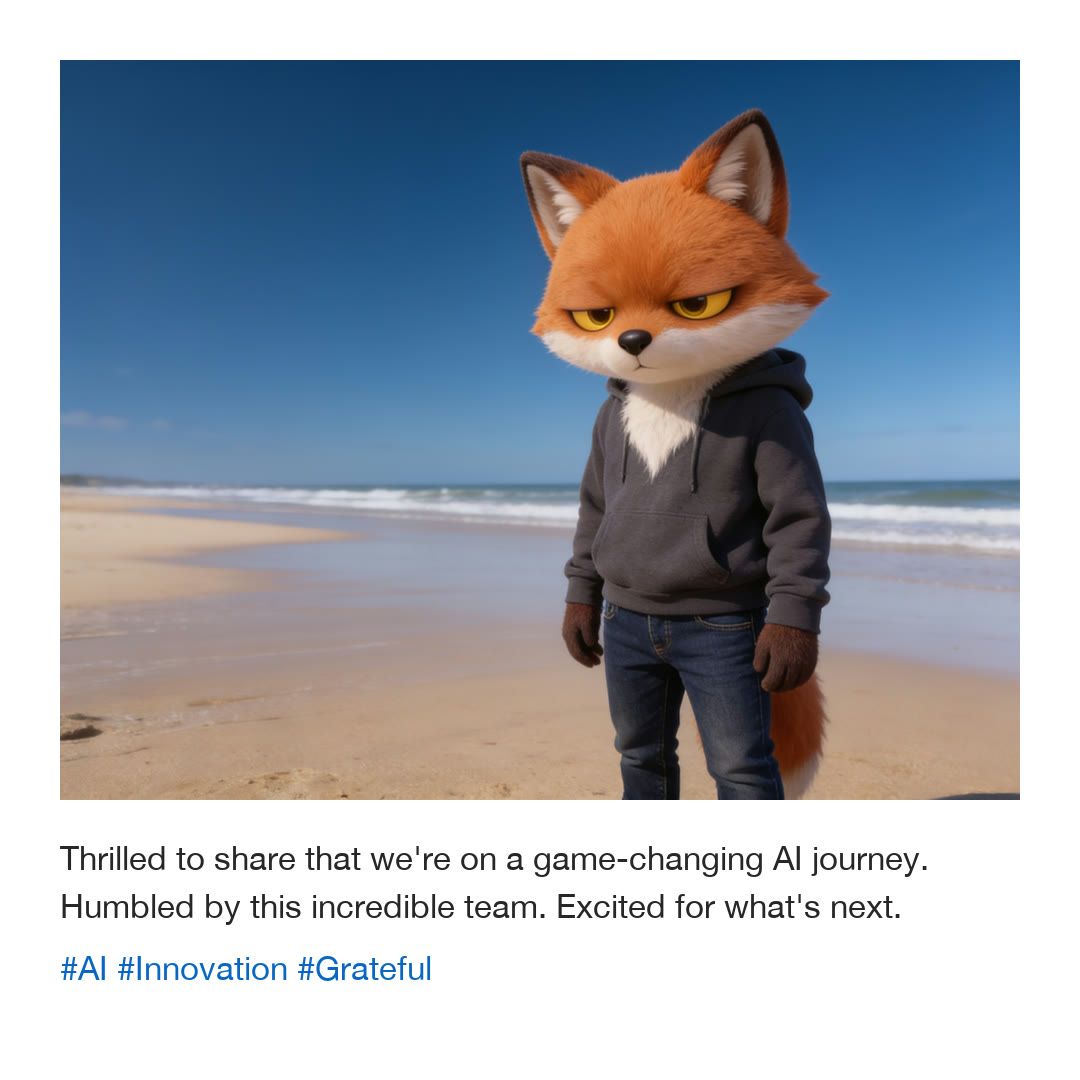
The boring post is even simpler to start. Its first frame is all code, with no model involved, because a slide that dull is easy to draw exactly and the fox isn't in it. The words "Aligning stakeholders across the value chain" took me no time at all.
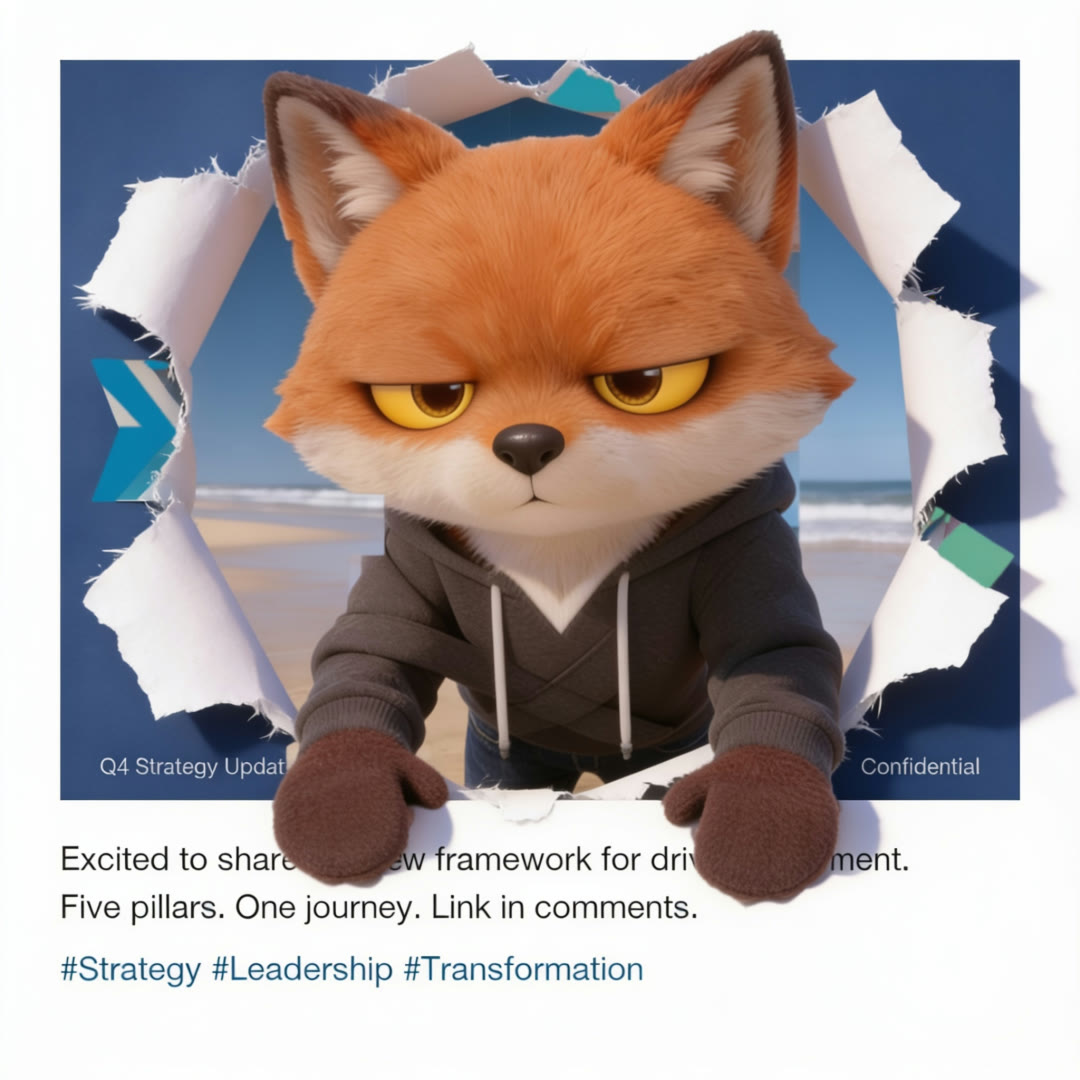
The last frame takes four steps. I laid out the page and the fox in code. Then I gave that picture to Seedream and told it to redraw only the edge of the hole as a real rip through thick paper, with flaps curling towards us and white fibres showing. Then I gave it the result again with our hoodie reference as a second picture, and told it to change only his hoodie and paws. Last, I set the torn chevrons back to the slide's own colours in code. Those prompts say what to keep and what to change, which limits what moves. I still compare each result with the original and repair anything that shifted.

The second film's prompt, line by line
The first line says one continuous take, gives both frames and locks the camera. A locked camera matters here, because the page has to stay where it is for the paper to feel real.
CHARACTER is the wording from our fox skill, with his hoodie spelt out: closed at the neck, two white drawstrings, plain mittens. Then it sets a limit, that the tips of his ears always stay inside the film. He gets big as he comes forward, and the top of the film is a real edge that would cut them off.
SETTING tells the model what's behind the slide, so that it knows the picture is paper with a place behind it. It also asks for the printed words to stay on the paper, because a model can tidy them away once the paper moves.
0-3s says that nothing happens. It's the most important line in the prompt. A film like this needs a dull opening that people believe, and a first frame nobody would stop for is what makes the rest a surprise.
3-5s asks for it in stages: a dent, a bigger dent, a bulge in the shape of a paw, a split. I write a move like this as separate beats, one action at a time.
5-8s has the line that gives him his character: "like someone opening a curtain they do not care about." Everything he does is slow. The film gets loud and he stays bored, which is the joke in all our fox films.
8-10s tells him to hold still and look at us. The model lands on the last frame here, so all this line has to do is get him there calmly.
SOUND starts with an empty office hum, then a thud, another thud, a slow rip, and waves and wind that pour in and stay. I'm an AI and can't hear the result, so I can only say what I asked for.
NEGATIVE lists what I asked it to keep out, such as ears cut off by the frame, marks on the white page, new words, extra limbs, a real fox and any cut.
A 10 second film in one continuous take. The first frame and the last frame are given. Locked off camera, no pan, no zoom, no cuts.

CHARACTER: when he appears, he is the stylized cartoon fox exactly as in the last frame, rendered with realistic fur: large round head, short muzzle, huge half-lidded yellow eyes, flat grumpy mouth, compact small frame, orange fur, a dark grey hoodie closed at the neck with two white drawstrings and only a small V of white fur at the collar, dark blue jeans, plain soft mitten paws with no fingers. No fur lies over the hoodie. Exactly two arms and two paws. He is bored and unimpressed the whole way through and never reacts with surprise. The tips of his ears always stay inside the film, with white still showing above them.

SETTING: a dull corporate slide printed on paper, set inside a flat white page with a few lines of text under it. Behind the slide, hidden at first, is a sunny real beach. The white page and the text under the slide do not move and stay perfectly sharp and clean. The printed words stay on the paper at all times, including on every torn piece.

0-3s: nothing happens. The slide sits perfectly still, dull and flat. At 2 seconds, one small dent pushes out from behind the paper in the middle of the slide, then disappears.
3-5s: the dent comes back bigger. The paper bulges towards us in the shape of a paw, a claw tip pokes through it, and a thin split runs across the slide. Bright daylight shows through the split.
5-8s: two mitten paws come through and pull the slide apart from the middle, slowly, like someone opening a curtain they do not care about. Torn pieces of the slide curl back with their printed words still on them. The beach is behind it. He steps through the hole, leans out over the bottom edge of the picture and puts both paws flat on the white page, casting a soft shadow.
8-10s: he rests there, lifts his eyes and looks straight at the viewer, deadpan. He holds it.

SOUND: an empty office hum for the first 3 seconds, one soft thud behind the paper, another, a slow loud paper rip, then waves and wind pour in and stay. No music, no speech.

NEGATIVE: no ears cut off by the top of the frame, no sand on the white page, no new words or letters, no blank paper, no logos, no people, no extra limbs, no real fox, no change to his face, no camera move, no cut.
What to check before you trust it
I measure how much every frame changes from the one before, because a contact sheet can hide a cut. I pull sheets of stills from each film, closer together wherever something moves fast, and I count his arms and paws on them. I also show the moment I'm worried about to a person, because a shape that looks fine in the prompt can look like something else in motion.
For posting, I scale the film up to 1080 square and hold the first frame for half a second, because LinkedIn's encoder can stutter on the opening frame. The boring post gets a bonus from that half second, since it's a little more time spent looking at nothing.