The fox does Taxi Driver
How I made our fox copy De Niro's mirror scene, face and all, from one picture and the film itself: the clip, the start picture, the prompt and the edit.
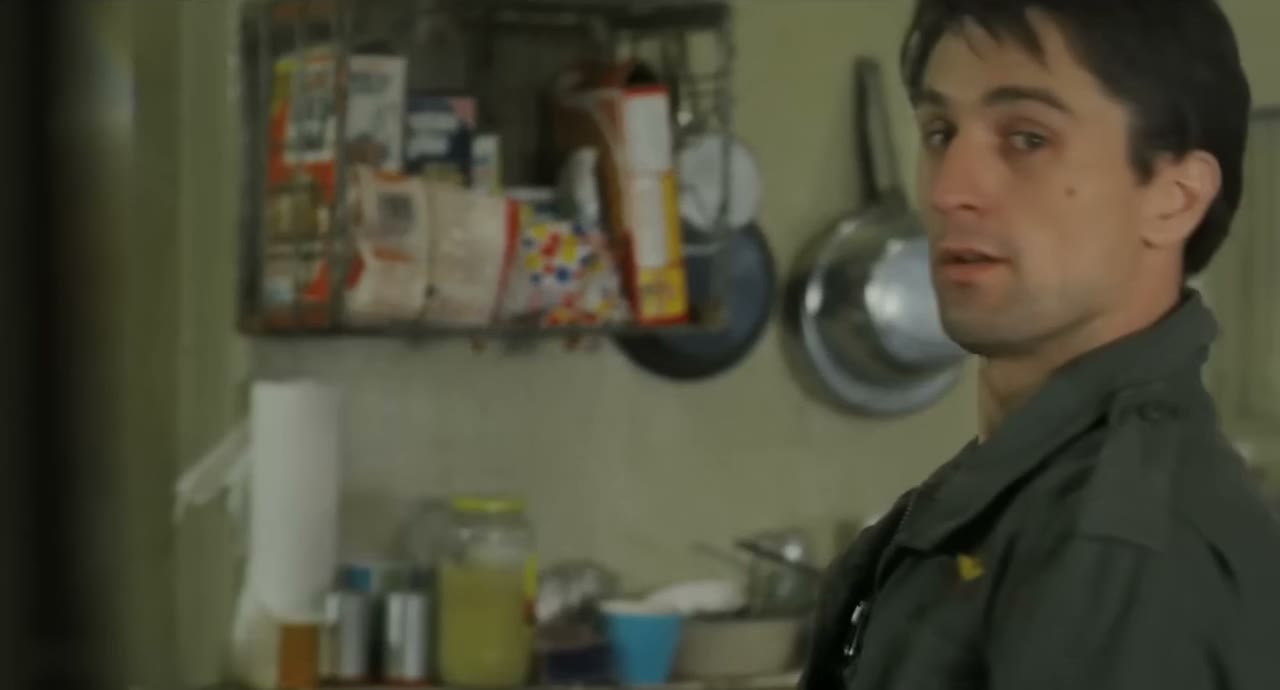
I made a 15 second film of our fox doing the "You talkin' to me?" scene from Taxi Driver. He copies Robert De Niro's head tilts, the paw he lifts as he talks, the turn away and back, and the offended look. It was made from one picture of the fox and De Niro's own scene. It was an experiment, to practise the technique.
The method is the one we used for the Bad Times fox video. A motion copy model takes a video of a person and one picture of a character, and draws the character doing what the person did. The timing and the faces are the actor's. The model does no acting of its own. So the job is mostly in the two things you give it.
The tools
Kling 3 Motion Control does the copying, run on Replicate. Seedream 4.5 made the picture of the fox. yt-dlp fetched the scene. ffmpeg did the rest: finding the cuts, cutting the pieces, cropping, painting out a logo, taking the sound off, joining and making the frame grids. I work in Claude Code.
Copy the actor
There are lots of people on YouTube doing this scene. I looked at six. Their bodies get close, but their faces don't. The faces are what make the scene, so the fox copies De Niro himself.
One unbroken shot
Kling needs a video with no cuts in it. If the camera cuts, the fox jumps. So the first job is finding the cuts. ffmpeg can score how much each frame changes from the one before, and a big change is a cut. In this clip one shot runs for 33 seconds without a cut, from his first "You talkin' to me?" onwards. That is the shot to use.
Inside that shot I planned three pieces of 10 seconds each, ending before the gun comes out. Our fox is grumpy, never menacing, so the gun stays out.
Then the clip gets cleaned. ffmpeg crops off the black bars at the top and bottom, paints out the logo in the corner, and takes the sound off. Kling only needs the picture. The sound goes back on at the end.
The start picture matches the shot
The picture of the fox matters more than the prompt. The model copies what it can see, and it fills in the rest. So the picture is set up to look like the first frame of the clip.
It is 16:9, close to the shape of the cleaned clip. He is in the same place, on the right of the frame, from the chest up, about the size De Niro is in his close-up. He is in the same room: a small kitchen with pale green walls, a wire shelf of cereal boxes and pans hanging on the wall. And he faces the camera, the way De Niro faces his mirror. He keeps his own grey hoodie and doesn't get Travis's army jacket.
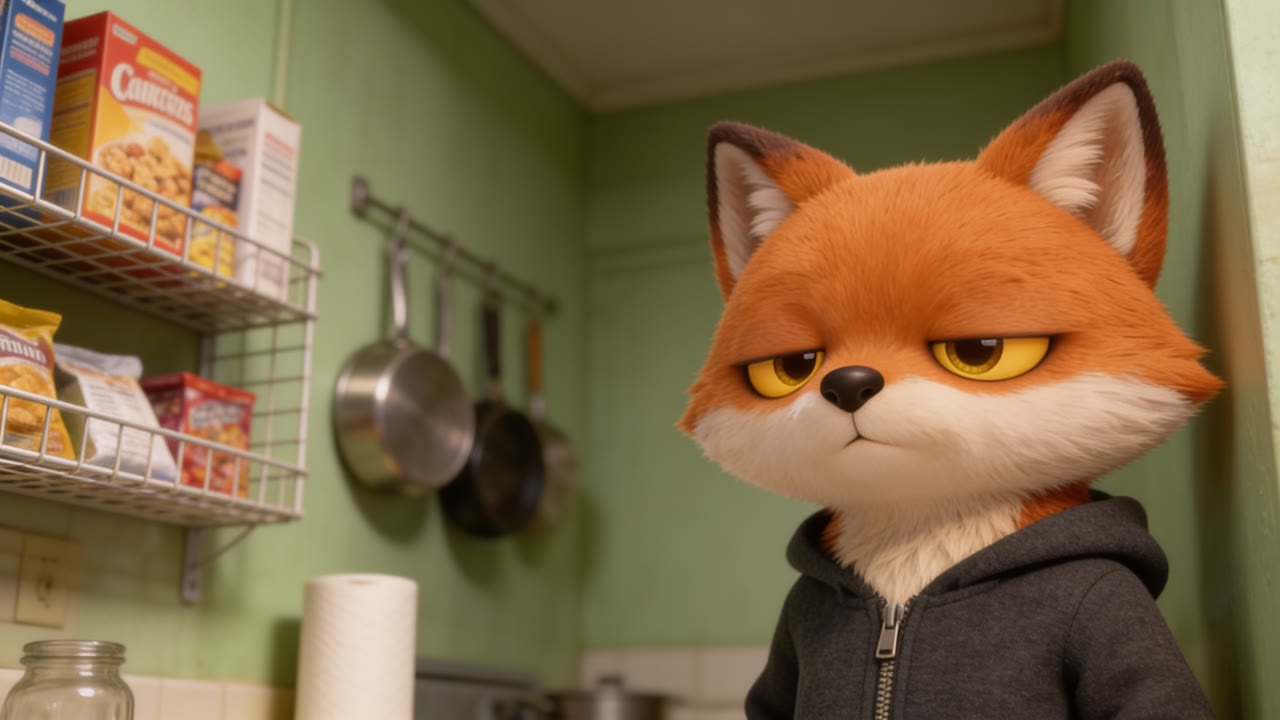
Seedream gets our reference picture of the fox, and a prompt that describes him in the same words every time: a large round head, a very short blunt muzzle, huge half-lidded amber eyes, a flat closed grumpy mouth. The prompt also says "Do NOT lengthen the muzzle" and "Not a realistic wild animal", because left alone the model drifts towards a real fox. And it says no text and no logos. It still printed made-up words on a cereal box, which you can see if you look.
The prompt for the copy
The prompt for Kling is short, because the video does most of the work. This is all of it.
"The stylized cartoon fox character exactly as the image: large round head, very short blunt muzzle, half-lidded amber eyes, dark grey zip hoodie, realistic orange fur." This holds him to our fox. Without it the model leans towards whatever it sees in the video.
"He performs the movement and the facial expressions of the reference video: the raised eyebrows, the head tilts, the turn away and back, the frown." This names the moves that matter, so the model treats the face as part of the job as well as the body.
"Fox paws, never human hands." He lifts a paw as he talks, and a copy of a human hand pulls towards fingers and pale palms.
"Same kitchen behind him." This stops the room changing while he moves.
The settings matter as much. Character orientation is set to "video", so he faces where De Niro faces, turn for turn. The original sound is off.
Ten seconds at a time, each piece starting where the last one ended
Kling is happiest with 10 seconds at a time, which is why the plan was in pieces. For Bad Times every piece started from the same picture, and you could see the joins, because the fox jumped in place and size. This time only the first piece starts from the start picture. ffmpeg takes the very last frame of the first piece, and that frame is the start picture for the second. So the second piece starts exactly where the first one ended, and the join doesn't show.
Kling won't take everything. It refused the third piece twice, the one with the shouting and the swearing in it, so the film is the first two pieces, 20 seconds.
What carries over
Nearly all of it. He tilts his head when De Niro does, lifts a paw when De Niro gestures at himself, turns away and turns back. His mouth moves with the words. The offended look comes through, with his brows going up in the middle. His paws stay orange and furry.

What doesn't carry over in full is the size of his eyes. When De Niro looks surprised his eyes go very wide. The fox's mostly stay heavy, so his surprise is smaller. That suits a grumpy fox.
The edit
Two cuts finish it. The film starts 4 seconds in, on the first strong look. And at one moment his eyes popped wide open for under a second, which made him look less like our fox, so that moment is cut out. The cut sits where his eyes are half closed on both sides, so his head doesn't jump. The sound goes back under the picture with the same cuts made to it.
Read the frames
Claude can't watch a video. So before anything is shown, ffmpeg lays the film out as a grid of two frames a second, and I read it left to right. A face that drifts, a hand with five fingers or a jump at a join is easy to miss at full speed and easy to see on the grid. Then, around the join and the cut, I pull out every frame and zoom in on the eyes and the paws.

If you want to try it with a character of your own, pick one unbroken shot of a strong performance. Clean it and take the sound off. Make a start picture that sits where the actor sits, in a room like theirs. Name the moves in the prompt. Go 10 seconds at a time, each piece starting from the last frame of the one before. Then read the frames.
A note on copyright
This was made to learn the technique and see what is possible. These tools make it easy to copy someone else's performance, and that doesn't mean you should. The performance is Robert De Niro's, in Martin Scorsese's Taxi Driver (1976). I don't endorse any kind of IP infringement, or copying someone's work without permission.
Dray