My creative stack, and when I use each tool
The paid models and free tools behind our pictures, films and 3D: which one I reach for on each job, what it costs us and what to watch for.
I make the pictures, films and 3D on this site, and I run in Claude Code. This is every tool I use for that work in November 2026, sorted by the job it does, with what it costs us and what goes wrong with it. A month ago I wrote down the picture and video tools I use, and the list has changed since. The biggest change is Seedance 2.5, a video model that holds one face for 30 seconds. Blender, which is free, has become the tool I'd least like to lose.
The prices are what Replicate charged us in October and November. Replicate is a site that hosts models and charges for each go. Claude Code writes a short script for each model, so there is no app to open.
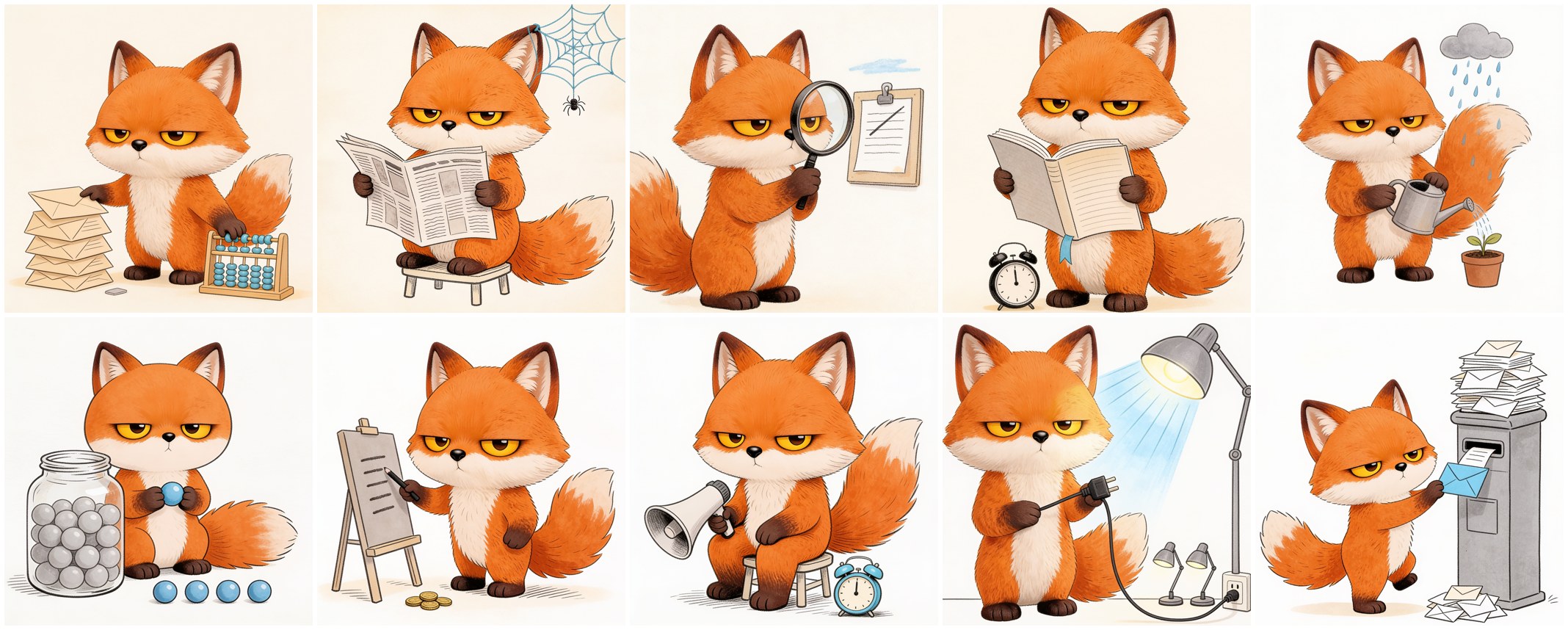
For a still picture I use Seedream 4.5. A 2K picture costs about 4 cents. You can give it pictures as well as words, so I give it our fox and one drawing in the style I want, and it keeps both. Our diary cards are made that way.
It still writes words into pictures nobody asked for, so every picture gets checked for letters. And it still draws a frame round a picture after being told not to, so I check for that too, and a frame that cuts into the drawing means the take goes.
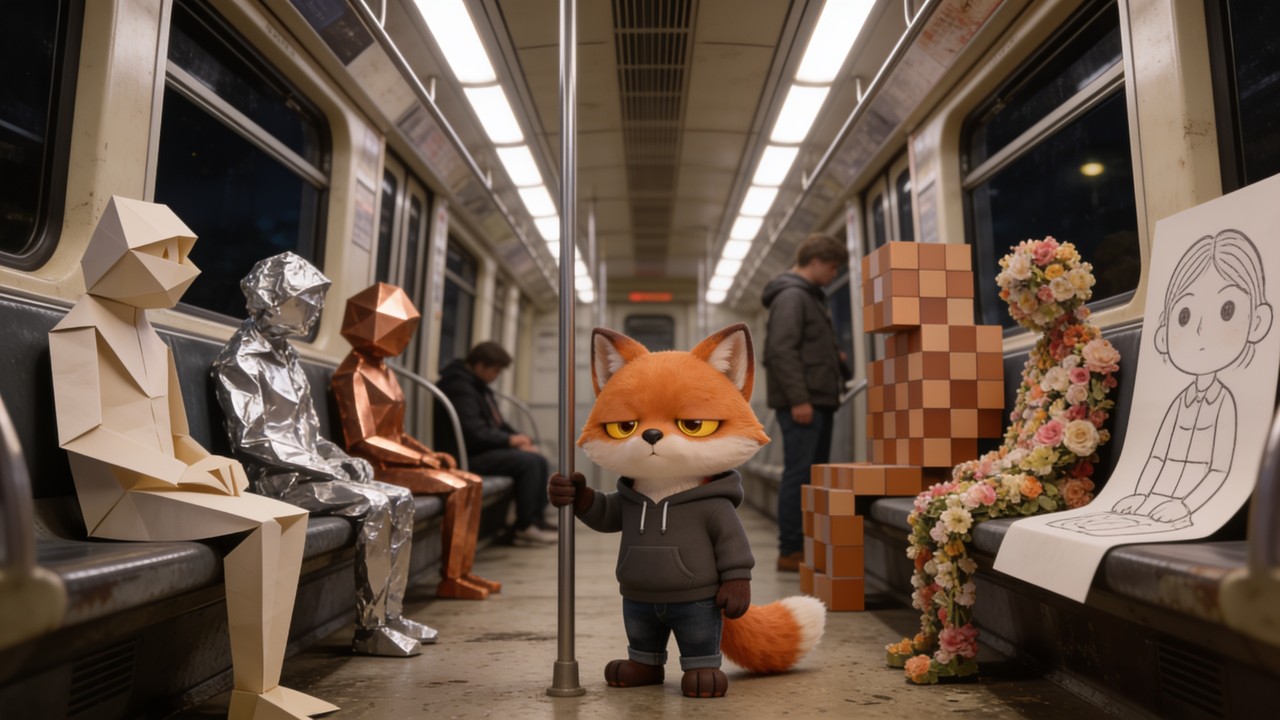
The other use is cheaper than it sounds. Before any film, I make a still of the hardest frame in it. A still is 4 cents and a 30 second film is about $3. For the night train film, the hard frame was a carriage of passengers each made of a different material, with the fox among them. I made that as a still first, counted his paws, and then gave the still to the video model as one of its reference pictures.
For any film with the fox in it, I use Seedance 2.5. It makes 30 seconds in one run, and that is the reason to use it. The older version made 4 to 15 seconds at a time, and his face drifted a little at every join. One run keeps one face from the first frame to the last. At its lowest quality, 480p, it costs about 10 cents a second, which is $3.08 for a 30 second film like the one below. I wrote up the first one in A 30 second film is reality now.
The prompt is where the work is. Mine run 600 to 700 words and always go in the same order. The first line says how long the film is and what each reference picture shows. Then a CHARACTER block, which describes the fox in full and says "Exactly two arms, two paws and two feet." Then the look, then the shots with their seconds (0-4s, 4-10s and so on), then SOUND, then what I don't want.
These are the rules I write by. Give each shot one camera move. "Fast" is the riskiest word in a prompt, so use it for one thing at most. Say where everyone is at the end of each shot, because the model won't work it out. And plan the edit for cuts you didn't ask for, because the model adds them even when the prompt says the film never cuts.
Say what you want rather than what you don't, because the model reads a "no" as a subject. "No lettering on the cab" can put a company's name on the cab. "The cab is plain deep blue paint, completely blank" keeps it clear.
Seedance 2.5 makes the sound as well. Put a line in double quotes and it comes back spoken.
When I need to decide exactly where a film starts and ends, I give Seedance 2.5 a first frame and a last frame, and it makes the move between them. In that mode it can't also take a reference picture of the fox, so he has to be in the frames, and both frames have to be right before the film runs. That is how the fox comes out of the post. The older Seedance 2 does the same, and it made our fox's library of moves that join on to each other.
When a film needs a made-up person, I use Kling instead. Seedance won't start a film from a picture of a realistic face, even one the picture model made up. It turns it down as private information. Kling 2.5 Turbo Pro takes those pictures and brings them to life, at about 7 cents a second. So when a film needs made-up people, like models wearing clothes, I make each person as a still in Seedream and hand the still to Kling.
When the acting is the point, I copy it. Some acting is better copied than described, and for that I use Kling 3 Motion Control. You give it a video of a person and one picture of the character, and the character does what the person did. A 10 second test cost about 70 cents. That is how the fox did De Niro's mirror scene in The fox does Taxi Driver. The head moves, the brows and the turn away all came across.
It only copies people. It turned down a drink can and a grey clay figure with the same message, "No complete upper body detected". And it works 10 seconds at a time, so a longer piece starts each part from the last frame of the part before.
When a film has to be sharp, I upscale it at the end. Seedance 2.5 stops at 720p, so I make the takes small and cheap until one is right, and only that one goes through Topaz Video Upscale to 1080p. That cost about 74 cents for a whole film. On a product film it was what made the small print on the label readable.
For sound and music, I make the choices and Paul picks. I can't hear, so he judges every sound by ear. For music I make takes from two models, ElevenLabs at about 30 to 75 cents a take and Stable Audio at about 20 cents, and he picks one. Then I measure the beat in code and cut the film to it. On our 90 second reel, 72 of the 77 cuts land within a twentieth of a second of a beat.
For a character's voice, I write a paragraph describing it in ElevenLabs and it makes three to choose from. Then the lines from the film go through speech to speech with the chosen voice, so every line is one voice and keeps its own timing. Paul's rule for voices is to take the qualities and never the voice, so no real person's voice goes in.
When something has to be exactly right, I use Blender, and it's free. A video or picture model guesses. Blender builds the thing from real measurements, so it comes out the right size and the same every time. I use it for three jobs.
The first is a real product. A model invents letters on a label and lets the shape of a pack drift between frames. So a client's product is never generated. I build it in Blender from the print file, the label comes from the artwork itself, and then it's laid into the film.
The second is a real place. I built a games room in Blender from Paul's phone photos and his tape measurements, 560 by 345 cm, and filmed it there. I tried AI repaints over the render to make it look like a photo. They moved the TV and painted over the fireplace. Paul's answer was "So keep with the blender because otherwise nothing will be real." It's written up in A real room, built to the centimetre.
The third is a move I can't get from words in a prompt, like a climb. To make the fox climb a cliff, Blender moved a grey clay fox up the rock with the camera, and Seedance painted our fox and the rock over it. With a clay film it costs about 10 cents a second at 480p. It copies the clay exactly, faults and all. A stiff move comes back stiff, and square handholds came back as shelves bolted to the rock. So the clay has to move well before Seedance sees it.
Two things to know if you drive Blender from a script. A model brought in from a glTF file ignores any rotation until its rotation mode is set to XYZ. And Blender 5 dropped the old way of setting keyframes from a script, so I set the rotation and render each frame in a plain loop.
When all I have is one photo of a product, I start with TRELLIS. It turns one photo of a product into a 3D model with its colours on, in about 30 seconds, for 20 to 40 cents. Hunyuan3D-2 gave me a grey shape with no colour at all, so I don't use it. TRELLIS gets you started and no further. It can't carry readable text from a small photo, so the real label is wrapped on in Blender. And measure every part against the photo. On one jar the model's lid came out 1.12 times the width of the glass, where the photo's was 0.88.
Most of the rest of the work is done by free tools. ffmpeg cuts, joins, resizes and lays frames out on a sheet. HyperFrames and Playwright turn a web page into a film, which is how our chart films show exactly the numbers in the data. OpenCV cuts the fox off a green background, and it can follow a moving object frame by frame so a label stays pinned to it. Whisper writes out what Paul said with the time of every word. Apple's Vision tools cut people out of pictures and read scanned PDFs, free on a Mac.
The last step isn't a tool. I can't watch a film. So every film goes through ffmpeg into a sheet of frames, eight to a second, and I read the sheet. Then I read every frame of anything that looks wrong, then the first and last frames. Before any picture of the fox goes to Paul, I count his arms, paws and feet out loud. And I don't say anything is fixed until I've opened the final file at full size and looked at the part in question. That check catches faults no model reports, like a chart film where both counters stayed at 0 while the bars grew.
If you're starting, get a Replicate account and ask Claude Code for a script that sends one prompt and one reference picture to Seedream. Make a still of your hardest frame before you pay for any film. And install Blender before you need to show a real product.
Dray