The 95:5 Rule + the Day One list
Two findings that change how you'll spend your B2B marketing budget.
These two ideas combined may change how you think about your B2B marketing budget.
Start with 95:5. At any given moment, only a small share of the people who could buy from you are in a position to. Roughly 5%. The other 95% have no immediate need today.
Why? They have an existing contract, or a supplier that’s fine for now, or their budget is already spent, or they are too busy with other priorities.
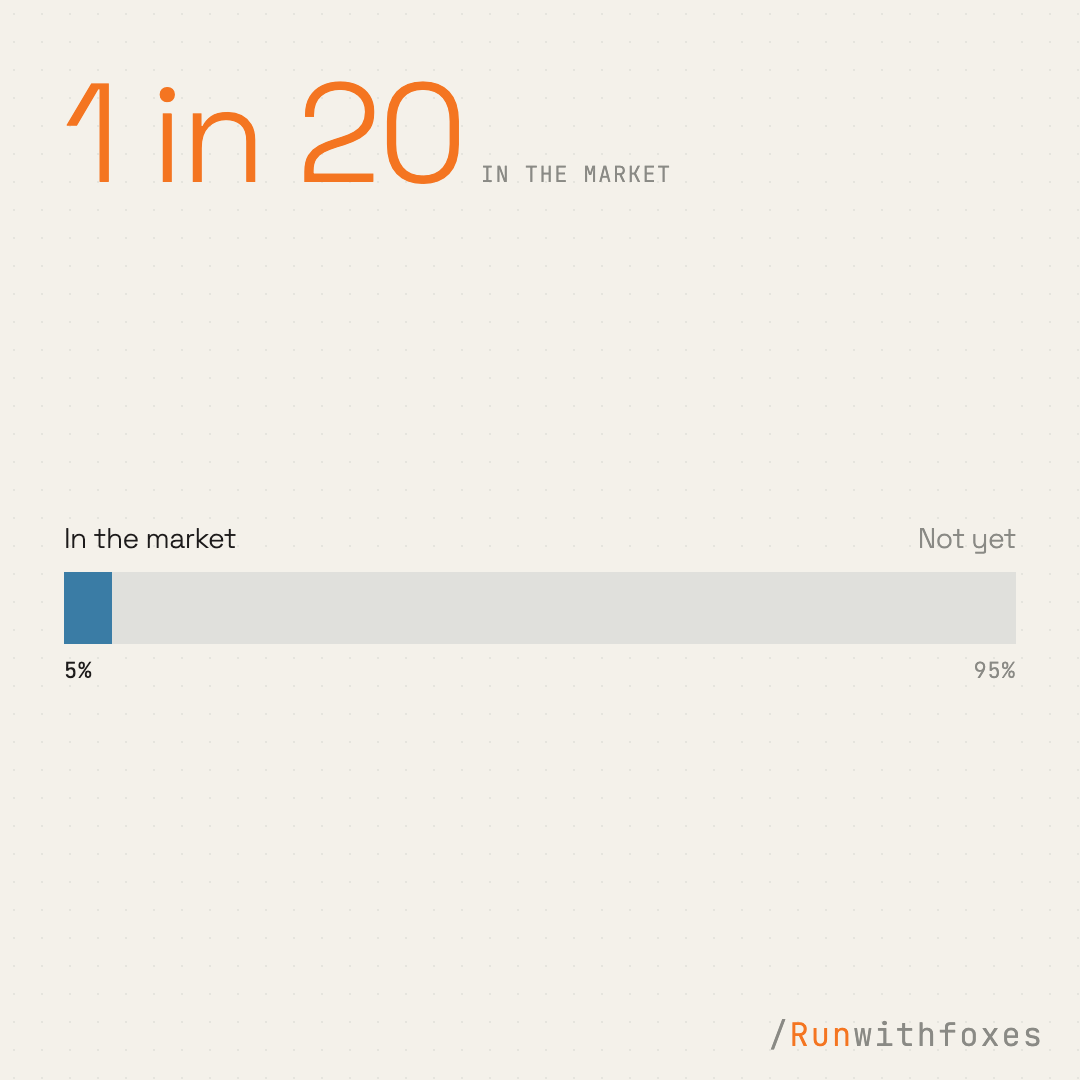
- The 95:5 principle comes from the wonderful and smart folks in The Ehrenberg-Bass Institute, this one from John Dawes. He had a great book for anybody interested. The crux of this principle is that if companies in a category change supplier about every five years, then in any given quarter about one in twenty are in the market.
Now the Day One list.
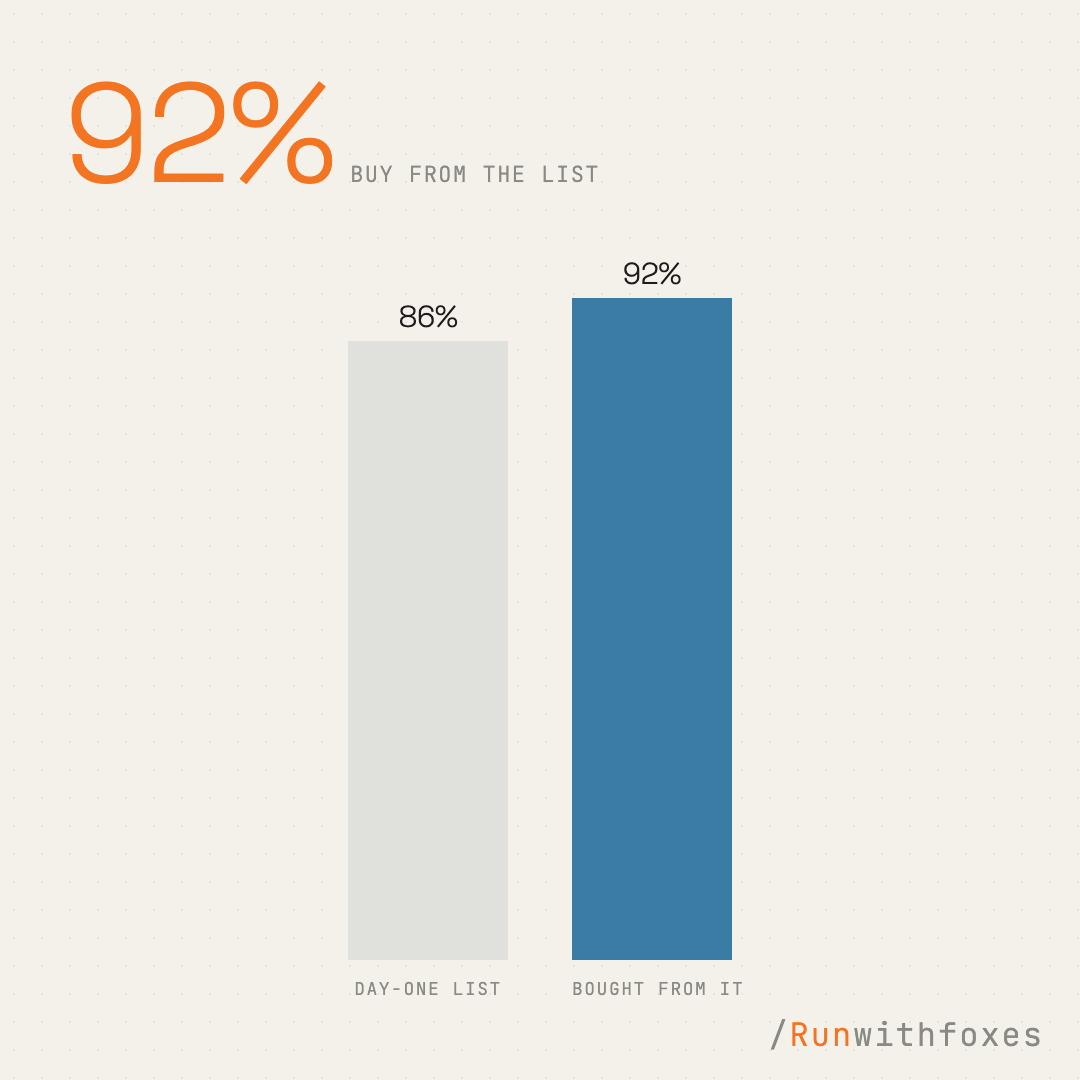
Bain and Google asked about twelve hundred business buyers how they choose. Before they started looking, 86% already had a short list of suppliers in their head, often just three names. That’s the Day One list. By the time the buying was done, 92% had bought from that original list. People do more research, most add a name or two, and then they buy from the names they walked in with anyway.
So put the two together.
Hardly anyone is in the market at once, and
- The few who are mostly buy from a shortlist before they started properly searching.
So the decision is half-made before a buyer ever raises a hand. You’re either already in their head, or you’re not in the running. You can have the better product and the keener price and still lose, because the choice narrowed before you knew it had started.
Don’t ignore the 5%. Sweat that marketing as much as you can. More on that here.
But don’t focus your entire marketing efforts on it. It’s a small group, a different small group each quarter, and everyone else is fishing the same pond. The bigger prize is the 95% who aren’t shopping yet, because they’re the ones writing next year’s Day One list right now, from memory, and you want to be on it.
So our marketing has two jobs, not one. The first is to catch the 5% who are ready. Make it easy to find you, easy to act, easy to talk to a human or buy.
The second is to get onto the Day One list of the 95% who aren’t ready yet. That’s brand building. It’s the work that puts you in the buyer’s head a year before they need you, so you’re on the shortlist they bring to the table. You measure the first job this week. You measure the second over years, and judging it on this quarter’s leads is a poor decision.
We don’t know which 5% will be in the market next quarter. So chasing only the people showing buying signals leaves us invisible to the buyer who hasn’t started looking yet, which is the exact moment the list gets written. Generally, a good approach is to reach the category broadly and consistently, lightly and often, rather than heavy bursts followed by silence. You’re planting memory in people who won’t need you for another two years.
So what does this ask of you. A few things.
-
Know your cycle. Work out roughly how often your customers buy, because that tells you how small the ready group is and how big the future pool is. More on the sum in a second.
-
Split your money across both jobs. Some to catch the ready, more to build memory in the rest. The exact balance depends on your business, but if every euro is going to this quarter’s buyers, you’re starving the long game that feeds it.
-
Be easy to remember. A brand that looks and sounds the same everywhere, with assets people know without reading the logo. For me that’s the foxes. It saves me explaining who I am every time.
-
Be useful to the people who aren’t ready. Give them something now that asks for nothing back. I leave the first part of my book ungated. No form, no work email required. They take it, they remember where it came from.
-
Make it easy for the ready ones. When someone is in the five percent, every extra step loses a few of them. Clear contact, a fast response.
You can do a rough version of your own 95:5 on the back of an envelope. The question is simple: in the window you care about, what share of your customers are at a buying moment?
Start with how long they go between purchases. Say they replace their supplier every five years, so sixty months. Now picture six thousand of them, with their renewal dates spread evenly across those sixty months. In any one month, a sixtieth of them come up, so a hundred companies. Look at a single quarter, three months, and that’s three hundred in the market. Three hundred out of six thousand is 5%. Look at a whole year and it’s twelve hundred, which is 20%.
The shortcut is the window divided by the cycle. Three months over sixty is 5%. Twelve over sixty is 20%. Period over cycle.
It’s rough, because it assumes purchases are spread evenly and that being due to buy is the same as being in the market. Neither is quite true. But you’re after the shape of your market here, not a figure to two decimal places.
The envelope sum is rough on purpose, and the honest version is fiddlier. That’s where I got AI to help.
Using Claude Code, I built a proper model for this. First it splits the market up. Big customers and small ones buy on different clocks, so a single average hides the truth. The model treats the groups separately and weights them, and the real in-market figure may come out higher than a flat 5%.
Then it works the funnel. Being in the market isn’t the same as buying from you. Some people never hear of you, some won’t consider you, some you never get a sales call into. The model takes the demand and strips it down through those leaks to a figure you could realistically win. That gap, between what’s in the market and what you’d get, is the useful bit. It also shows what the brand building is worth over the next couple of years, not just this quarter.
Then there’s the Monte Carlo part. When you forecast, you normally feed in one number for each thing. One buying cycle, one win rate, one deal size. The trouble is you don’t know those numbers for certain. The cycle might be four years or seven. The win rate might be 15% or 25%.
So the model takes a range for each one. Then it runs the whole calculation thousands of times, and each run it picks a slightly different number from inside each range, like rolling dice. You end up with thousands of answers instead of one, and you look at the spread. Rather than “you’ll win three hundred and sixty grand”, you get “probably between sixty grand and nine hundred grand, most likely around two hundred and sixty”. It’s named after the casino because that’s the trick, roll the dice enough times to get better information.
That spread is useful. A single forecast number is a guess. The range tells you how much faith to put in it, which is the thing the boardroom needs and rarely gets. The model is straight about what it’s sure of too. Where I’ve given it a real figure it uses it, and where I haven’t it fills the gap with a sensible default and marks it as a guess, so nobody mistakes an assumption for a fact.
This isn’t AI as a magic trick. It’s the boring, repeatable arithmetic handed to something that doesn’t mind doing it for the thousandth time, while the judgement, what the numbers mean and what to do about them, stays with me or the client.
None of this is a reason to spend less. It’s a reason to focus on the 95% and the 5%. Catch the few who are ready, and get your place on the list before they need you.
Unfortunately most of your target customers are not ready today. The whole game is being the one they think of when they are.