Marketing spent twenty years fragmenting itself into smaller and smaller jobs.
Brand marketer. Performance marketer. CRM specialist. SEO lead. Social strategist. Lifecycle manager. Content designer. Email automation expert. Analytics lead. Research lead.
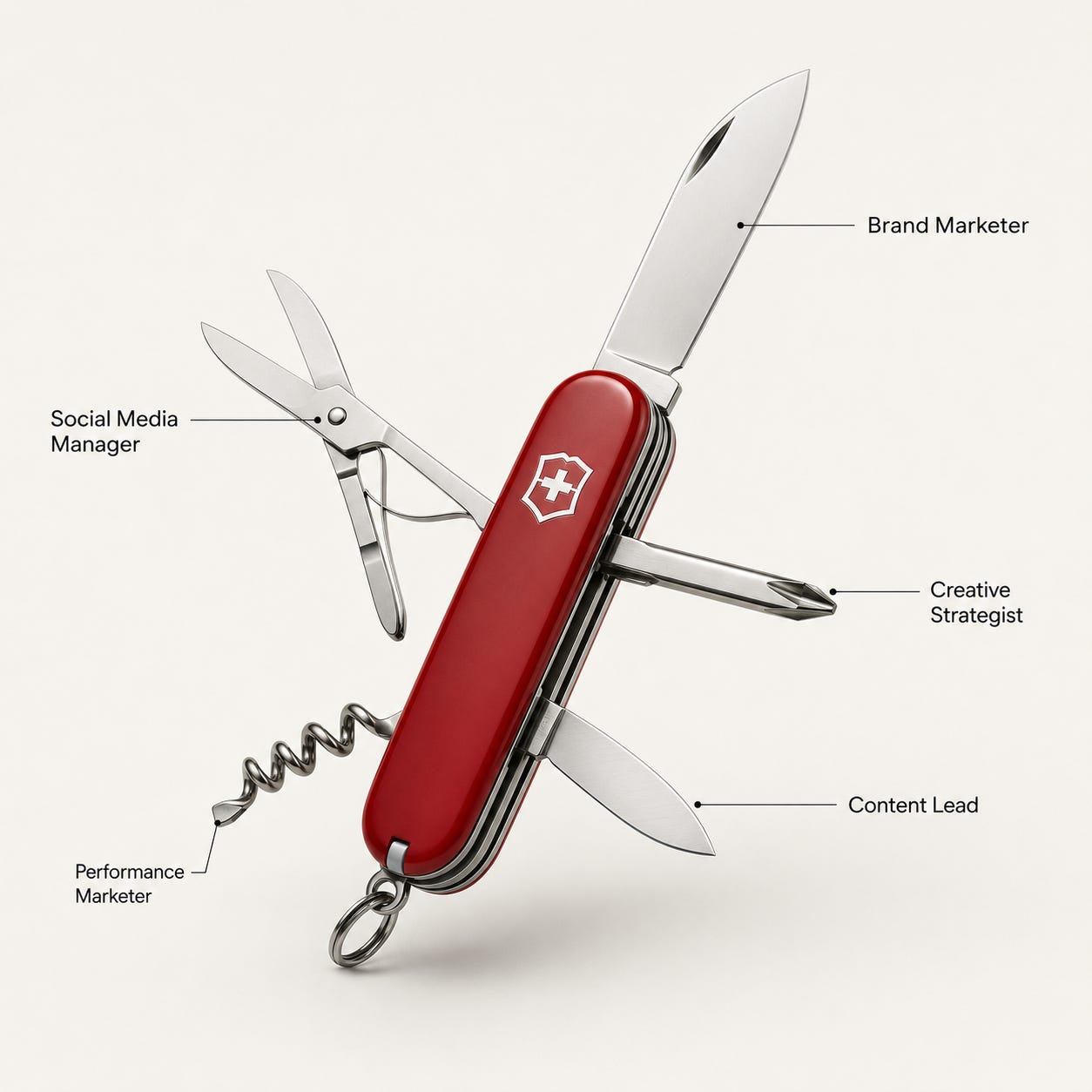
It made sense when the tools were hard.
If you wanted a landing page, you needed a designer and a developer. If you wanted customer analysis, you needed an analyst with SQL access and a week of patience. If you wanted research synthesis, you needed a planner. If you wanted pricing analysis, you needed someone from finance who owed you a favour. I traded in coffee-favours as standard.
So marketing became a relay race. Lots of handoffs. Lots of waiting. Lots of “can you put a ticket in for that.”
One marketer can now analyse customer interviews, synthesise research, build a prototype, create presentations, automate workflows, generate strategic options, analyse pricing models, interrogate datasets, write code, edit creative and produce decent execution, often without needing deep expertise in each discipline. Not perfectly. But good enough to make a lot of decisions, to ship stuff, to make some bets.
The advantage is no longer being the world’s best at one tiny thing. The advantage is being able to connect things together quickly. The marketers who thrive over the next decade will probably look less like narrow specialists and more like adaptable operators. People with a core strength, but broad capability across the whole commercial system.
That doesn’t mean expertise disappears. I spent most of my career as a brand marketer (if that is a thing). This is still what people usually contact me about - positioning, brand management, advertising effectiveness. But in the (recent past), that meant relying heavily on specialists around me. Designers, developers, analysts, researchers, production teams, strategists.
Now I can do things myself that would previously have required multiple people or agencies. Not because I’ve became an elite designer, developer or data scientist overnight, but because the tools lowered the barrier enough for me to do a lot of it myself.
Not everything. If you need a global brand re-launch with a multi-market campaign, I’m going to call in some of my expert specialist contacts to help this happen. But even for the big brands I managed - most of what we did were not these moments.
The people who may struggle most are the ones who define themselves too tightly by one function.
When your identity is attached to a role that’s shrinking, AI feels like a threat. When your identity is attached to learning and solving problems, it feels like a better set of tools.
A younger marketer entering the industry today has an even bigger opportunity. They can become dangerous across multiple domains very quickly. A few hours of focused learning with modern AI tools can compress weeks of confusion.
My advice? Stop seeing roles as fixed identities and start seeing them as capabilities we can learn. You probably won’t become the best data analyst, filmmaker or pricing strategist in the world. But you may become good enough to ask better questions, test ideas faster and execute without waiting for six departments and a Jira ticket.
The marketer who can connect research to strategy to execution to analysis without handing it off four times will just move faster than the ones that cannot.