LinkedIn ads benchmarks for 2026
Median click-through rate 0.69%, median cost per click $11.04, median cost per thousand impressions $78.30. Here are the latest LinkedIn ads benchmarks, what's behind them, and how to use them without fooling yourself.
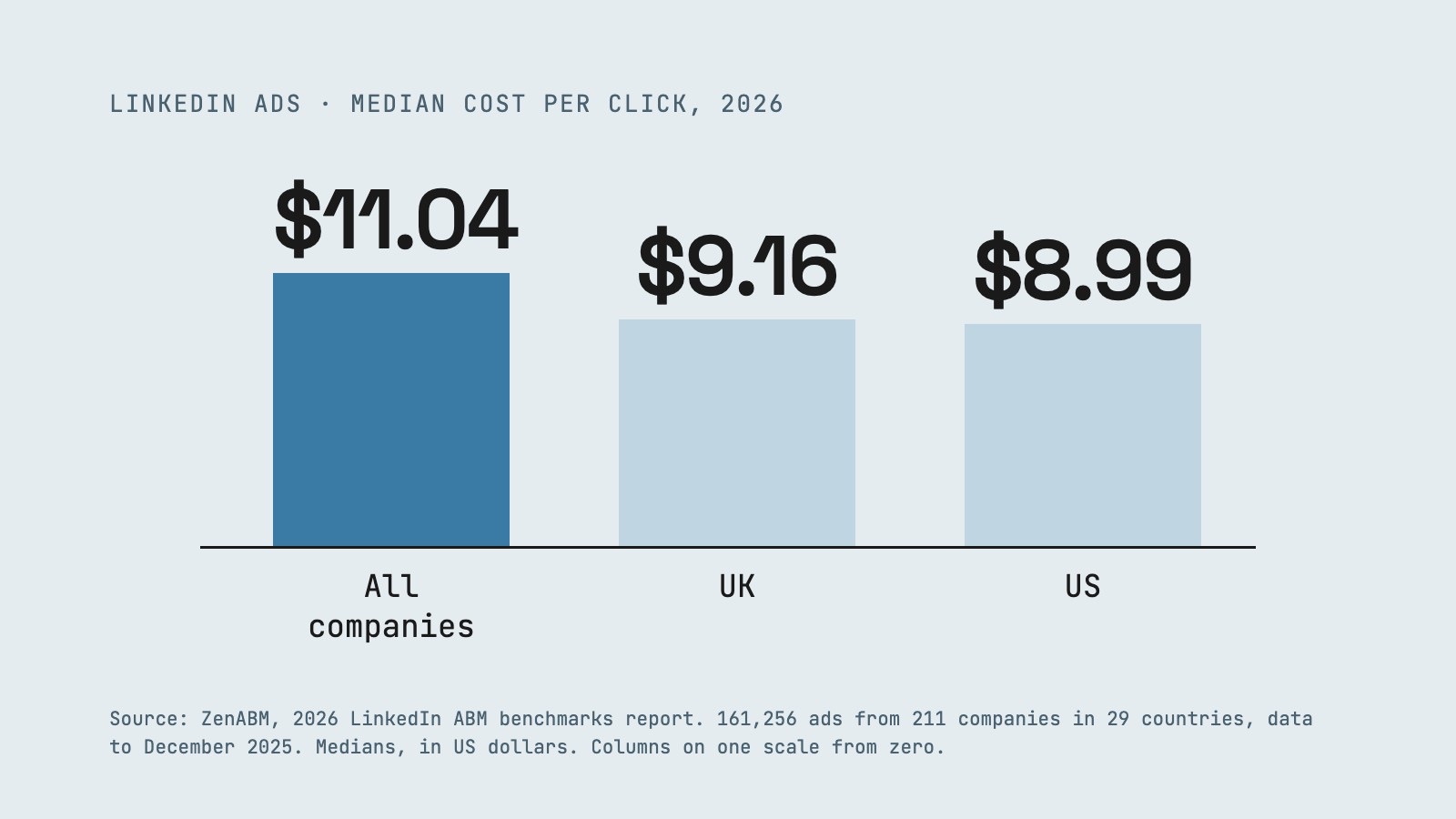
The largest recent LinkedIn ads benchmark we've found, ZenABM's 2026 report, puts the median click-through rate at 0.69%, the median cost per click at $11.04 and the median cost per thousand impressions at $78.30. It's built from 161,256 ads run by 211 companies in 29 countries, with data to December 2025. LinkedIn doesn't publish its own benchmarks, because, in its words, "there isn't a set cost per result. It's auction-based."
What the benchmarks show
Across all the companies in ZenABM's report, the medians were a 0.69% click-through rate, an $11.04 cost per click and a $78.30 cost per thousand impressions. The median company spent about $2,700 a month.
By country, the UK came in at a median click-through rate of 0.55%, cost per click of $9.16 and cost per thousand impressions of $56.62. The US was 0.52%, $8.99 and $62.67. For Ireland the report gives averages rather than medians: a cost per click of $11.43, a cost per thousand impressions of $73.34 and a click-through rate of 1.16%. It doesn't say how many Irish advertisers that's based on.
By format, from a smaller part of the report covering 2,828 ads from seven B2B software companies, single image ads had a median click-through rate of 0.42% and cost per click of $13.23. Thought Leader Ads, which promote a post from a person's own profile, had a median click-through rate of 2.68% and cost per click of $2.29. But only 0.29% of people who saw a Thought Leader Ad clicked through to the landing page, because most of their clicks are likes, comments and profile views.
All figures are in US dollars.
What's behind the numbers
Benchmarks are only as good as the accounts behind them. ZenABM's data comes from its own users, who lean towards B2B software companies doing account-based marketing, often targeting senior people at specific companies. That's an expensive audience. A firm advertising to a broader professional audience will usually pay less, and one targeting chief executives in finance will usually pay more.
The report's own tables don't always agree with each other on some figures, which is common in vendor research. Treat the numbers as a rough guide to the range, not as precise targets.
How to use benchmarks without fooling yourself
This part is our advice.
Compare like with like. A Thought Leader Ad's click-through rate and a single image ad's aren't measuring the same thing, and a campaign aimed at awareness shouldn't be judged on clicks at all.
Look past the click-through rate. It's the easiest number to report and the least useful. What matters is whether you're reaching the right people, enough times, and what it costs to get a lead or a conversation from them.
Judge reach campaigns on reach. Most B2B buyers aren't in the market at any given time. Research from John Dawes at the Ehrenberg-Bass Institute suggests only about 5% of business buyers are in market in a quarter. So a LinkedIn campaign building your brand with the other 95% will look poor on clicks and leads, and that's not a sign it's failing.
Build your own benchmark. After a month or two of steady running, your own numbers are a far better guide than anyone else's. Track them month by month and judge changes against your own past.
Read next: How much do LinkedIn ads cost?, What is the 95:5 rule in B2B marketing? and What's a good cold email reply rate?.
This note was drafted with AI and checked by Paul Dervan before it was published.
Sources
ZenABM, 2026 LinkedIn ABM benchmarks report: zenabm.com. LinkedIn Help, bidding strategies: linkedin.com. John Dawes, Ehrenberg-Bass Institute, "Advertising effectiveness and the 95-5 rule", May 2021: marketingscience.info.